
This article examines the history of Syria’s Fine Arts Association (FAA), a key institution that helped shape the country’s art scene in the 1970s under the rule of Hafez al-Assad [Official publications often referred to the Fine Arts Syndicate as an “association,” particularly in French translations; accordingly, the terms “association” and “syndicate” are used interchangeably throughout this essay]. It explores how nationalist-socialist discourse intersected with artistic and institutional practice, leading to the instrumentalization of art as a political tool while generating tensions within the cultural field. Tracing exhibitions, debates, and artistic practices, the article highlights this field’s complexity and the range of positions it contained, from ideological commitment and instrumentalization to forms of internal critique.
The FAA was founded in Damascus in 1969 during the wave of reforms implemented by the Baath Party leadership after Syria's secession from the United Arab Republic. The historian Afif Bahnassi (1928-2017) assumed its leadership. The FAA’s stated goal was "to draw inspiration from nationalist[1] heritage and folk arts in developing Arab art and situating it within the mainstream of world art,"[2] while emphasizing the need to "place art in all its fields at the service of the Arab masses and to draw inspiration from their emancipatory and national causes."[3] This goal was pursued through the FAA branches in Damascus, Aleppo, and Homs. Bahnassi was widely known for his support of artists and his strong presence in the Syrian cultural field, which he enriched through historical studies and essays. At the same time, he participated actively in debates over the necessity of grounding artistic practice in a socialist identity. He rejected the principle of “art for art's sake” and urged artists to distance themselves from artistic trends he regarded as Western or unprogressive. Instead, he called for the creation of art that was, first, Arab, and second “functional” and “ethical.” In a 1965 article titled “Socialism and Art,” written while he was Director of the Fine Arts Department at the Ministry of Culture and Nationalist Guidance, Bahnassi reflected on the influence of social systems on forms of creative life: “It is true that artistic work transcends material labor, in the sense that it relies on a special and sometimes extraordinary ability, but this does not absolve creative work from responsibility.”[4] Bahnassi repeatedly argued that artistic creativity expresses civilizational advancement and forms an integral component of national development: “The return on consumer labor appears as a numerical increase in the quantity of production, whereas the return on artistic labor appears as a civilizational increase in the evolution of nationalist history,” as he put it in the same article. In his view, capitalist production is oriented toward profit, encouraging artists to pursue superficial pleasures or to transform art into marketable consumer commodities - as in ready-made products - that generate enormous profits in the West.[5] For this reason, he argued that the first condition of socialist art is to liberate the artist from the “diseases that afflict him through importation and imitation, or through psychological crisis or sick imagination.”[6] Through this analogy, Bahnassi framed artistic creativity as potentially dangerous unless it remained “sound,” conformed to accepted standards, and was ultimately harnessed for political and social purposes.
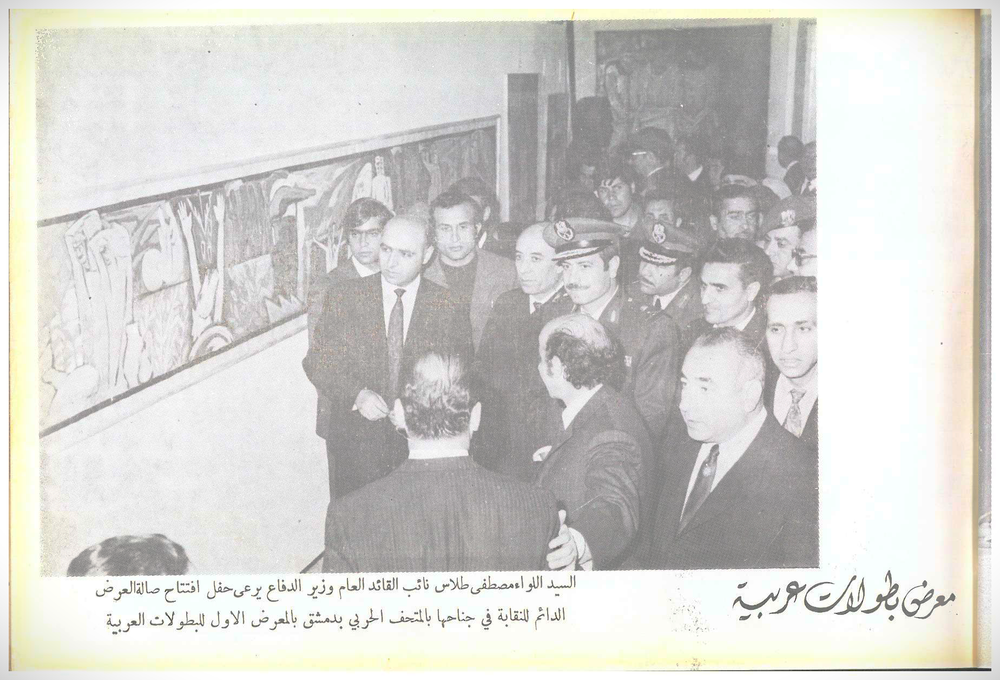
Page from the Al-Funoon al-Jameelah, a non-periodical publication issued by the FAA, 1972
It is worth noting that this understanding of the role of art and the artist found broad resonance within Baathist discourse, which presented itself as socialist and which the Assad military government appropriated as part of its cultural language. In 1971, the FAA opened an official exhibition hall under the patronage of Brigadier General and Prime Minister Abdul Rahman Khleifawi (1939-2009).[7] Two years later, in 1973, the hall was relaunched by Prime Minister Mahmoud al-Ayyoubi (1932-2013) under the new name “People’s Hall”, marking the twenty-sixth anniversary of the founding of the Arab Socialist Baath Party while adopting the slogan “Art for the people, art for all.”[8] The FAA also organized traveling exhibitions, seminars, and celebratory events across Syria’s governorates under titles such as The Arab Championships Exhibition (1972), The Dignity Exhibition (1973), and The Tribute to the Revolution Exhibition (1973). Other exhibitions were staged in state institutions linked to agricultural and industrial production, including the Khamaseen Factory and the Tabqa Dam on the Euphrates (later known as Lake Assad).[9] In addition, the FAA issued a non-periodical publication that it described as a “statement of account presented to the citizen.”[10] The publication documented its union struggle and presented “to party and state officials the achievements realized during the year.”[11] Through photographs, statistics, and reports, it sought to demonstrate its efforts to place the artistic movement within “its proper nationalist framework” and to remind the Arab artist of their responsibilities in contributing to the goals of the Arab nation in construction and liberation.[12]
Discourse on art was closely interwoven with politics in the FAA’s publications. It gradually positioned itself as the principal representative and authoritative voice of Syrian national art. It asserted that it had “created an audience that appreciates art and follows it seriously and with special interest … through an open and frank dialogue through which the aspirations of our masses toward purposeful art are realized … based on its nationalist and civilizational responsibilities.”[13] In this way, its language became deeply embedded in the official ideological discourse of the state. The FAA repeatedly emphasized that it had only begun to flourish and fulfill its true role following the Corrective Movement coup by Hafez al-Assad,[14] claiming that it had succeeded in “bridging the gap that separated the artist from the citizen.”[15]
At the same time, the FAA sought to cultivate close ties with art associations and ministries of culture across the socialist bloc. In Damascus, two exhibitions were held in 1972: one on Polish film posters and another on the Korean army. In 1973, two further exhibitions were devoted to Soviet and East German printmaking. In 1975, the city hosted an exhibition of contemporary Bulgarian tapestry, among others. The FAA also welcomed visiting artists through cultural exchange agreements. One such agreement, concluded in 1976 between the FAA and the East German Association of Visual Artists (VBK), led to the participation of German artists and diplomats in joint activities. Among them were the artist Walter Womacka (1925-2010), who accompanied the FAA on a visit to the Golan Heights to witness what were described as Israeli violations, and Horst Weise (1919-1993), Secretary-General of the VBK, who oversaw the organization of the joint exhibition.[16]
The FAA’s publications also featured photographs documenting the participation of military units and officials in cultural events. Among the figures shown attending exhibitions and seminars were Major General Mustafa Tlass (1932-2017), Rifaat al-Assad (1937-2026), and members of the Baath Party’s Regional Command. The publications likewise included images of marches in which FAA-affiliated artists joined public demonstrations pledging allegiance to the president. This indicates an early state-sponsored iconography that would remain a defining feature of the Syrian public sphere for decades.
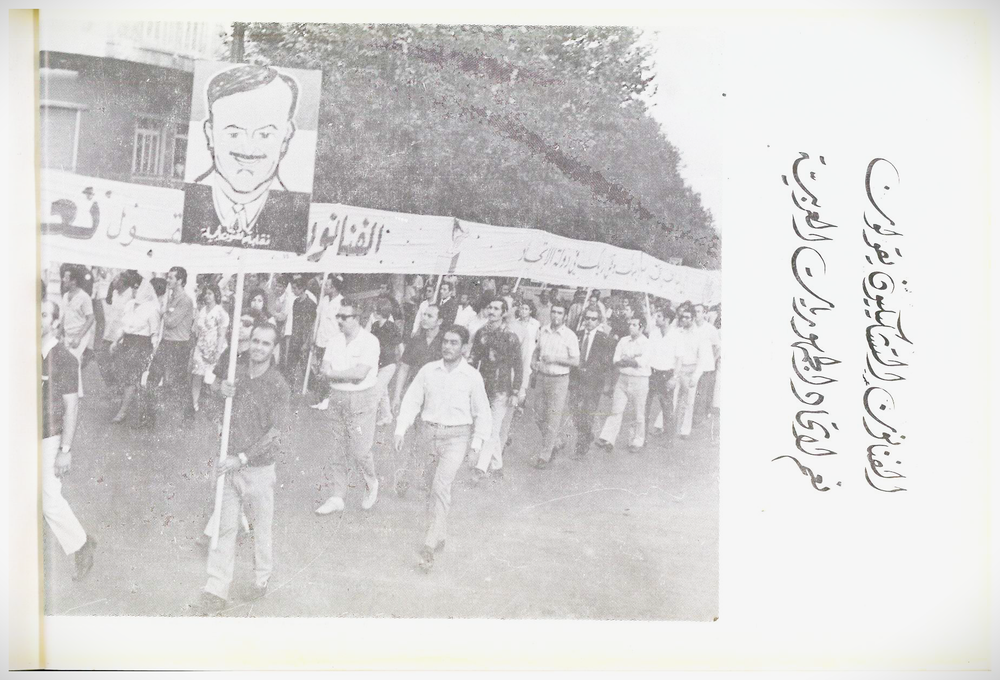
Page from the Al-Funoon al-Jameelah, a non-periodical publication issued by the FAA, 1972
In practice, all organizations and associations - whether those of artists, lawyers, doctors, engineers, farmers, or teachers, as well as mass organizations such as the Revolutionary Youth Union, the Student Union, the Women’s Union, and the Baath Vanguards - were expected by the party leadership to participate regularly in demonstrations expressing loyalty to Assad and affirming allegiance to his as “the nation’s vicegerent.” Through legislation, most notably the Emergency Law, all activities of independent associations were tightly restricted, and civil society was effectively marginalized. Membership in associations and unions became conditional upon affiliation to the ruling Baath Party and adherence to its ideological principles. The regime sought to engineer a social order in which individuals were integrated from an early age into a dense network of party-aligned organizations, thereby placing them under security monitoring. This project echoed the framework outlined in Baath Party’s Regional Command documents that spoke of “popular democratic rule.” In this formulation, “organized classes within a revolutionary party and militant popular organizations assume the reins of power, restructure the country’s political authority, and use it to advance the revolution.[17] Party documents further emphasized that popular organizations should serve as “the face of the party, defending its slogans and explaining its positions … [through which] the party presents its goals and policies on a broader scale.”[18]
Public speeches, marches, and celebrations were organized in union offices for every national occasion. Their buildings, like government and private premises, were adorned with literary slogans and images of the “beloved leader.” These mass demonstrations were not merely displays of popular support. They also functioned as instruments through which the regime imposed discipline and control: public performances of power and collective rehearsals of obedience, carried out within a political environment that compelled people to participate and chant slogans regardless of personal conviction. This dynamic is analyzed by the scholar of Syrian politics Lisa Wedeen in her book Ambiguities of Domination: Politics, Rhetoric, and Symbols in Contemporary Syria.[19] The rituals of allegiance that extended to the cultural sector, particularly through the widespread circulation of official imagery, transformed authority from an abstract concept into a tangible presence in everyday life.[20] The military regime frequently exploited the talents of artists to promote its image, employing calligraphers and painters to produce banners and portraits of the president, or assigning them to press offices as designers of magazines and publications glorifying the achievements of the Baathist revolution. A revealing example is the story of the artist Omar Hamdi, known as Malva (1952-2015). He was assigned to work as an illustrator for Al-Fursan, the newspaper of the Defense Companies commanded by Rifaat al-Assad. Hamdi spent seven full years in the magazine's office, well beyond the duration of his mandatory military service, without compensation, without permission to relocate his residence, and without any institution - such as the Artists Syndicate - having the authority to defend him or others in similar circumstances. He eventually fled Syria in 1978.[21]
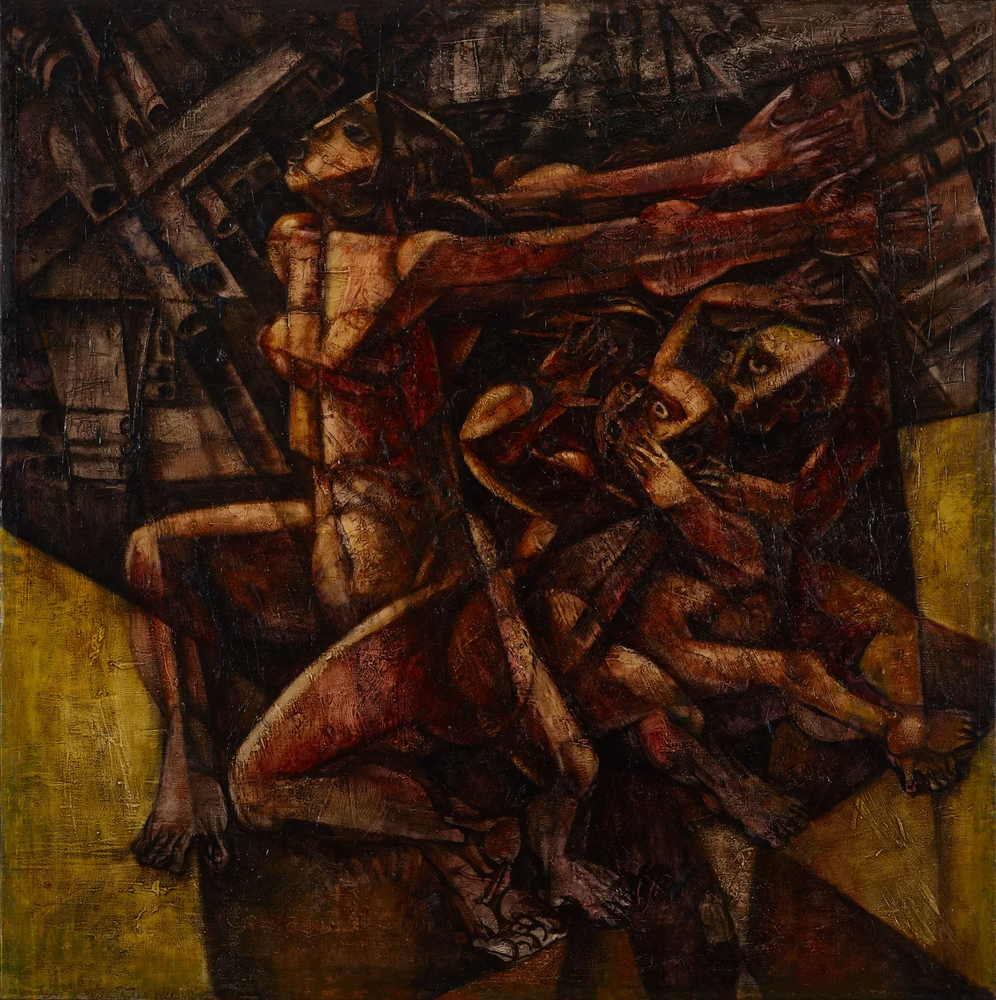
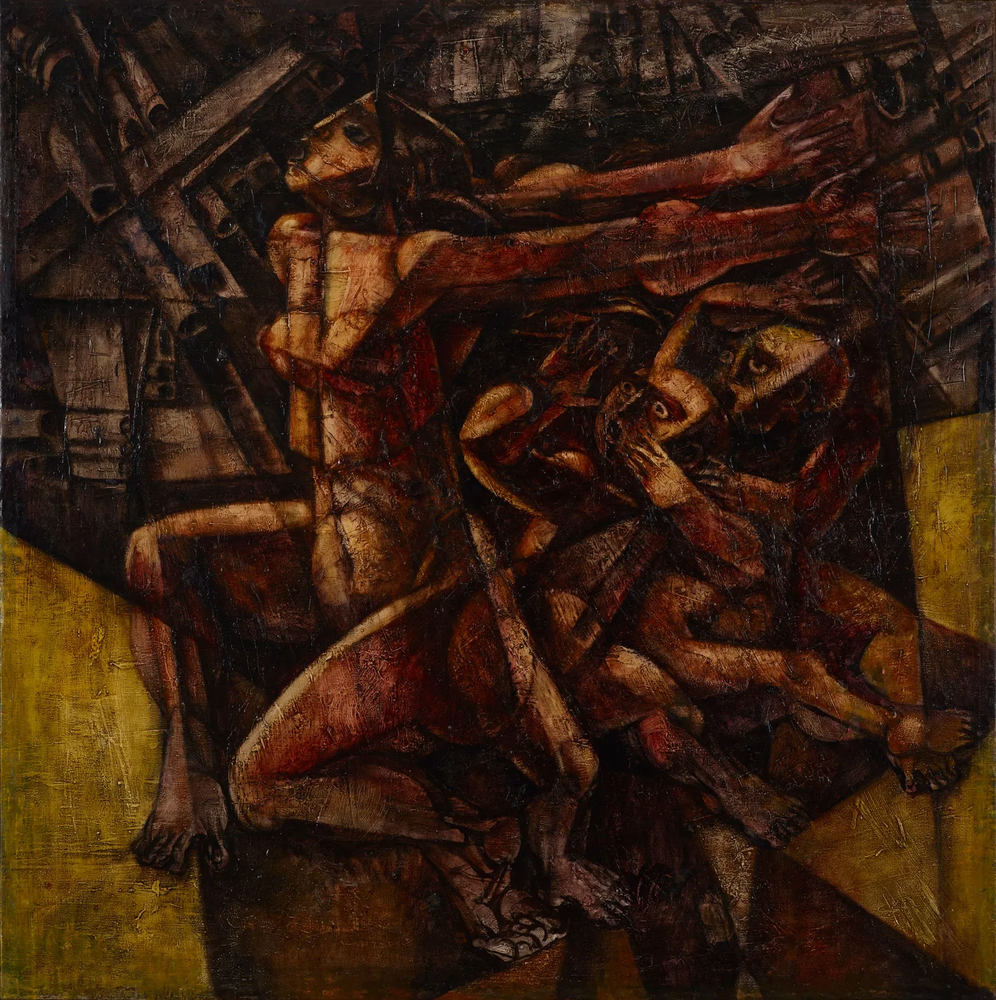
Nazir Nabaa, “Children of Bahr al-Baqar,” 1970, 125 × 125 cm, oil on canvas
The painting was exhibited at the Ten Exhibition organized by the Press Syndicate in 1970
Source: Dalloul Art Foundation website
Participation in the FAA exhibitions, as well as in the annual exhibition organized by the Directorate of Fine Arts at the Ministry of Culture and Nationalist Guidance, was significant. Beginning in the 1970s, these exhibitions became the primary venue for Syrian artists, particularly as the private art scene was increasingly marginalized. Prominent figures such as Fateh Moudarres (1922-1999), Mahmoud Hammad (1923-1988), Nazir Nabaa (1938-2016), and Nasir Shoura (1920-1992) were almost always present. Prizes were awarded to the best works by a committee composed of two members from the General Staff of the Army and Armed Forces (one of whom served as chair), two representatives from the Ministry of Culture, and two members from the FAA. Once the prize was awarded, the winning artwork - along with full rights of ownership, including the right to sell or otherwise exploit it - was transferred to the Supreme Command of the Army and Armed Forces.[22] Although the slogans of pan-Arab nationalism lost their appeal for many after the Syrian army’s defeat by Israel in 1967, Syrian cultural discourse - and with it many artistic works - remained closely tied to nationalist causes.
One example was the initiative taken by FAA member artists such as Ghazi al-Khalidi (1935-2006), Nazir Nabaa (1938-2016), and Mamdouh Kashlan (1929-2022) following the Israeli air force bombing of a primary school in Bahr al-Baqar, Egypt in 1970. In response, they presented paintings as artistic commentary and protest against the humanitarian catastrophe. Similarly, during the October War of 1973, the FAA converted its hall on al-Firdous Street in Damascus into a workshop in 1973. This was followed by the opening of the exhibition “The Citizen and the Battle” in October 1974, featuring artists such as Mamdouh Kashlan, Ghazi al-Khalidi, Leila Nseir (1941-2023), Youssef Abdelke (b. 1951), Omar Hamdi, and Burhan Karkutli (1938-2003), among others. The FAA also invited artists to visit Quneitra to mark its liberation from Israel after the October War between - an event celebrated by the regime as one of the achievements of the Corrective Movement, prompting many artists to accept the invitation.
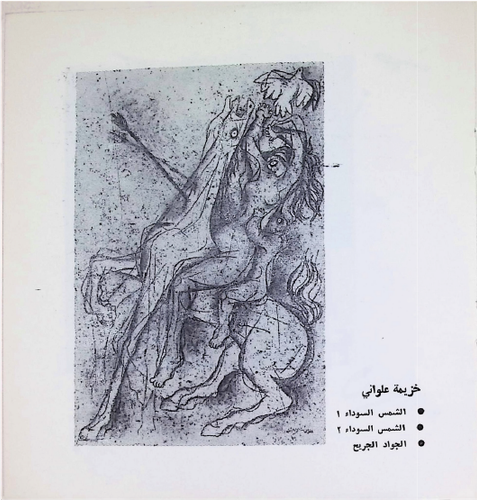
A page from the booklet of the Ten Exhibition, Damascus, 1971
showing the artwork “The Wounded Horse” by Khouzayma Alwani
The FAA was keen to foreground themes associated with pan-Arab nationalism in its exhibitions. The figure of the woman, for instance, frequently appeared as a symbolic representation of the homeland, freedom, the wounded nation, or the violated fertile land. Anwar Diab painted her nearly nude, seated in contemplation with a dove of peace in her arms. In the black-and-white exhibition booklet, the image appeared within an abstract space filled with asymmetrical forms. The work was also shown in the FAA’s 1972 exhibition. In his painting “Why?”, Mamdouh Kashlan likewise depicted the figure of the woman simultaneously as child and adult, a resistant and protective presence with angry red eyes standing behind the bodies of fallen men. The work employed the strong colors and simplified geometric forms associated with Expressionism. It was shown at the FAA’s 1971 exhibition. Fateh Moudarres also contributed to the same exhibition with a painting titled “A Girl from the Golan.” Another recurring motif in Syrian art of the period was the horse, often employed as a symbol of Arab identity. One of the most striking examples came from the artist Khouzayma Alwani (1934-2025). First shown in Damascus at the Press Syndicate Exhibition in 1970, the drawing depicts a wounded Arabian horse screaming in terror, its wide eyes conveying intense pain.[23] On its back, Alwani placed a woman and child collapsing together as they reach toward a dove flying away. The work clearly echoes Pablo Picasso’s Guernica but inflects it with an Arab symbolic vocabulary: the horse symbolizes the wounded soul of the nation, while the woman-mother is the final reservoir of hope in the face of the war machine. The painting served simultaneously as political commentary and as a universal human cry against injustice and violence. Through such works, artists sought to render catastrophe starkly visible, in keeping with the reformative function of art.
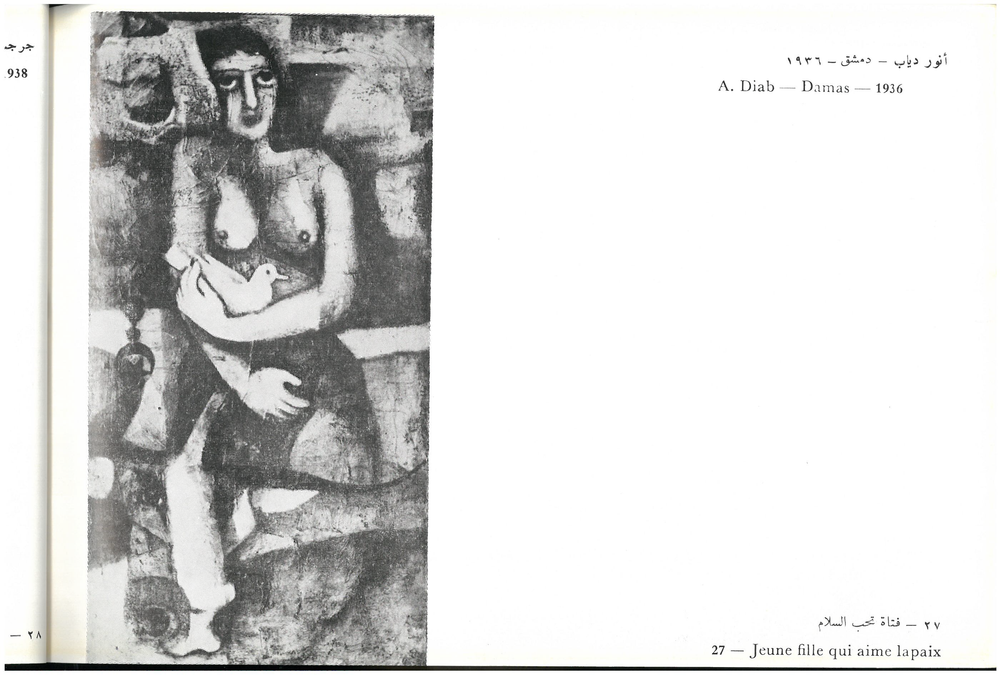
A page from the 1972 Syndicate exhibition booklet showing the artwork “A Girl Who Loves Peace” by Anwar Diab
While it is difficult for researchers to ascertain the political views of individual artists, much less to determine their attitudes toward the regime, the Baath-sponsored FAA undoubtedly benefited from the intense patriotic climate of the 1970s. By encouraging artists to engage with political themes and by circulating Baathist cultural discourse, both within Syria and beyond, its exhibitions played a role in legitimizing the broader ideological agenda of the regime. One of the most significant events organized by the FAA at the Arab level was the “First Arab Festival of Nationalist Plastic Arts” in 1971. The festival was established by decree of the then Minister of Defense Mustafa Tlass and commissioned by President Hafez al-Assad. Its stated aim was “to affirm the contribution of the Arab plastic artist to our struggle against colonialism and Zionism.”[24] Framed around “the important role of art in expressing the struggle and aspirations of the Arab nation,” the program included an Arab exhibition featuring artists selected for their nationalist works, screenings of films documenting foreign aggression and Arab steadfastness, visits to refugee camps, and a public seminar on nationalist art.[25]
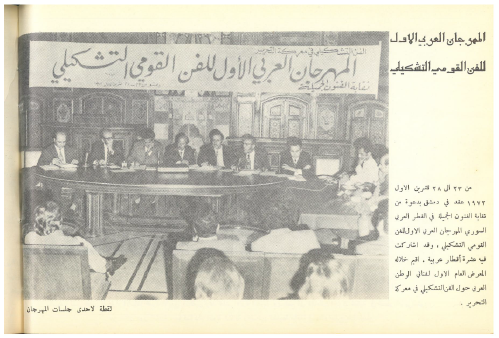
A page from Al-Funoon al-Jameelah, a non-periodical publication issued by the FAA, 1973
The photograph shows the historian Afif Bahnassi, Ghazi al-Khalidi, and Mahmoud Hammad
Source: Modern Art Syria Archive (MASA) platform
Yet the remarks of participating artists revealed a tone quite different from the official rhetoric. In a speech delivered by the Syrian artist Mahmoud Hammad, one of the organizers, he called for critical reflection on the very notion of “nationalist art.” Notably, he cautioned against attempts to “dictate artists’ direction or impose specific frameworks” such as Arab art. As he observed: “When a historian uses the term ‘Arab art’ to describe the sum of what Arab artists have created, or ‘Spanish art’ to describe what artists in the Iberian Peninsula have produced, the name comes after these arts already exist. Their existence was not the result of programs imposed upon them. They were the natural expression of hopes and aspirations shaped by their cultures and by the spirit of their successive societies, just as it was natural for those societies to struggle, to speak, and to sing.”[26]
Hammad’s remarks warned against the use of labels such as “Arab” or “authentic” to turn the artistic endeavor into an instrument of political projects in which creativity is reduced to mobilization and the freedom of expression pursued by himself and others over the previous two decades is curtailed. In his view, art does not emerge from ready-made slogans, but from immersion in lived experience and the free exploration of form and content. Identity-based categories, he argued, belong to interpretation after the work is created, insofar as they reflect the artist’s creative experience rather than prescriptions imposed in advance.
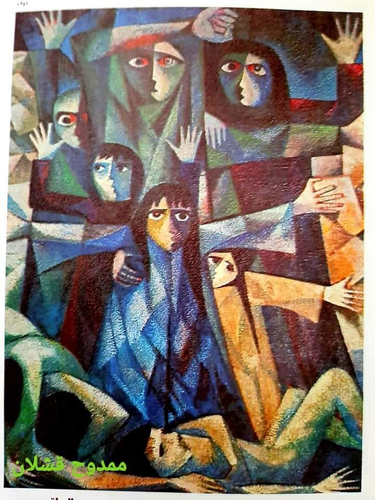
Mamdouh Kashlan, “Why?” The painting appears in the booklet of the first FAA exhibition in 1971. Source: the artist’s Facebook page
Yet the aspirations of those working in the creative field remained deeply intertwined with the political discourse of this period. To understand this dynamic, it is necessary to recall the efforts of artists who preceded the later festivals and who sought to realize a long-standing ambition.[27] Since 1962, some Syrian artists had hoped to convene a comprehensive pan-Arab conference. This ambition was finally realized in December 1971 with the “First Arab Conference of Fine Arts,” organized in Damascus by the FAA. The conference received support from the new Syrian authorities, which likely sought to present themselves as an emerging cultural force in the region and as a champion of the ideal of Arab unity, particularly following the death of Egyptian President Gamal Abdel Nasser. Participating Arab artists drafted a series of recommendations addressed to the Arab League, combining national slogans with organizational demands. They began by condemning the Israeli occupation of Palestinian territories and the Iranian occupation of Arab islands, while affirming the role of art in the struggles for construction and liberation in the face of colonialism, Zionism, and exploitation. The participants proposed that the Arab League establish a permanent headquarters for a pan-Arab artists union, including an exhibition hall, lecture hall, library, and archive all under the union’s authority. They also called for Arab artists to be granted freedom of movement and employment across Arab countries, for the allocation of full-time positions, and for art education to be incorporated as a core subject in schools. In addition, they recommended that artworks circulating within the Arab world be exempt from customs duties. Finally, the conference urged the Arab League and the Palestine Liberation Organization to document and protect Palestinian cultural heritage and to establish a museum dedicated to its preservation in order to safeguard it from Israeli appropriation and falsification.[28]
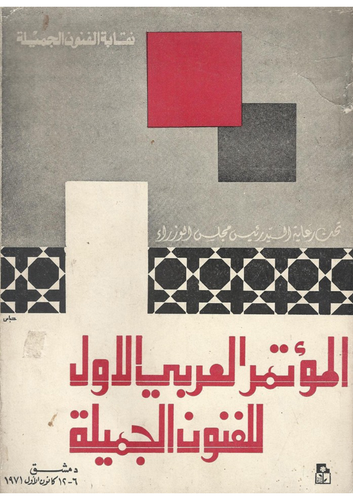
Cover of the brochure for the Arab Fine Arts Conference held in Damascus
Source: Mahmoud Hammad’s archive on the Modern Art Syria Archive (MASA) platform
The conference led to the convening of the first conference of the Union of Arab Plastic Artists (UAPA) in Baghdad, which resulted in the formal establishment of the organization. The Iraqi artist Jamil Hamoudi (1924-2003) was appointed head of its founding committee,[29] while the Palestinian Ismail Shammout (1930-2006) served as Secretary-General.[30] The UAPA’s most notable achievement following its creation was the organization of the First Arab Biennial in Baghdad in 1974. Widely regarded as a major success, the exhibition featured approximately seven hundred works - including sculpture, painting, printmaking, and ceramics - with significant participation from Syrian artists. Subsequent biennials were held in Rabat and later in Libya,[31] after which the initiative eventually came to an end.[32]
To underscore the centrality of the Palestinian cause as the cause of the entire Arab world, the UAPA announced that its official headquarters would be located in Jerusalem, with Baghdad serving as a temporary seat due to prevailing circumstances.[33] This symbolic choice reflected a desire to affirm a shared set of principles, one that resonated strongly with the discourse adopted and actively promoted by the Syrian Baath. Even when some ideological slogans appeared vague or unconvincing to many, the aspiration toward a unified identity - grounded in a rich Arab heritage and the prospect of a renewed Arab civilization - remained influential for large segments of the cultural field.
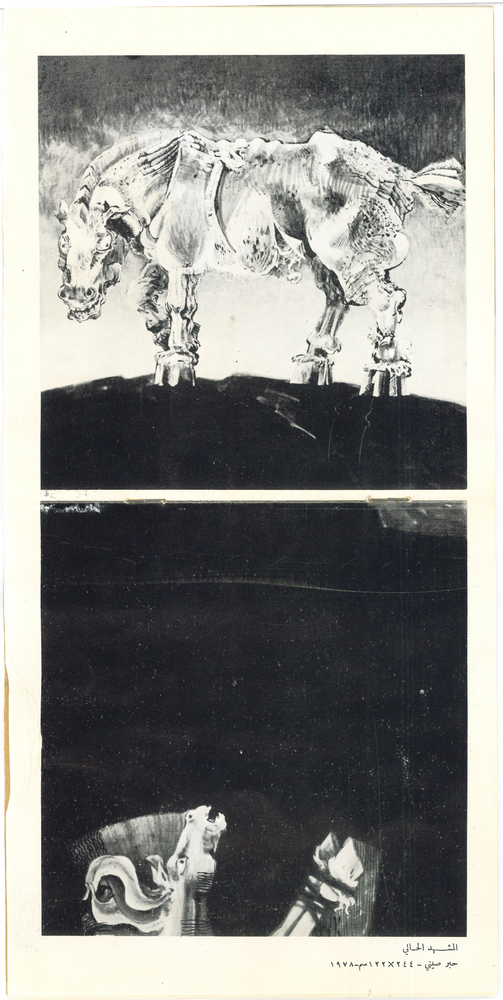
A photograph from the brochure of Youssef Abdelke’s exhibition at the People’s Hall, 1976
showing the artwork “The Present Scene,” Chinese ink on paper
Over time, however, the heavy instrumentalization of nationalist themes, particularly the Palestinian cause, often for propaganda purposes or to justify repressive measures, provoked growing frustration among a younger generation of artists and, over time, led many to avoid the subject altogether.[34] The theme came to be seen less as an expression of solidarity with a grieving people than mere political propaganda. As a result, certain artists adopted the same visual vocabulary in order to subvert it and offer a critical counter-reading. Among the most notable of these artists was Youssef Abdelke (b. 1951), who organized an exhibition at the People’s Hall of the FAA titled “Horses and Anti-Horses.” In his work “The Present Scene” (1978), the upper register features a wild horse that appears almost mechanical or armored, with metallic muscles and joints: its flesh torn, its mouth twisted into a frenzied grin, and its eyes rabid. Below it appears a contrasting figure: a terrified and restrained creature seemingly emerging from darkness or being swallowed by it. The stark opposition of black and white, combined with the absence of fine detail, intensifies the emotional impact of the composition. Another work from the same exhibition, “September,” presents a mass of horses whose bodies merge with war machines, forming a violent, entangled mass in a catastrophic scene. With this exhibition, Abdelke entered a sensitive terrain: his imagery could easily have been subsumed under the same state-directed discourse. Yet he used the very tools he denounced to mount a political and artistic critique, undermining and dismantling the symbolism of power from within.
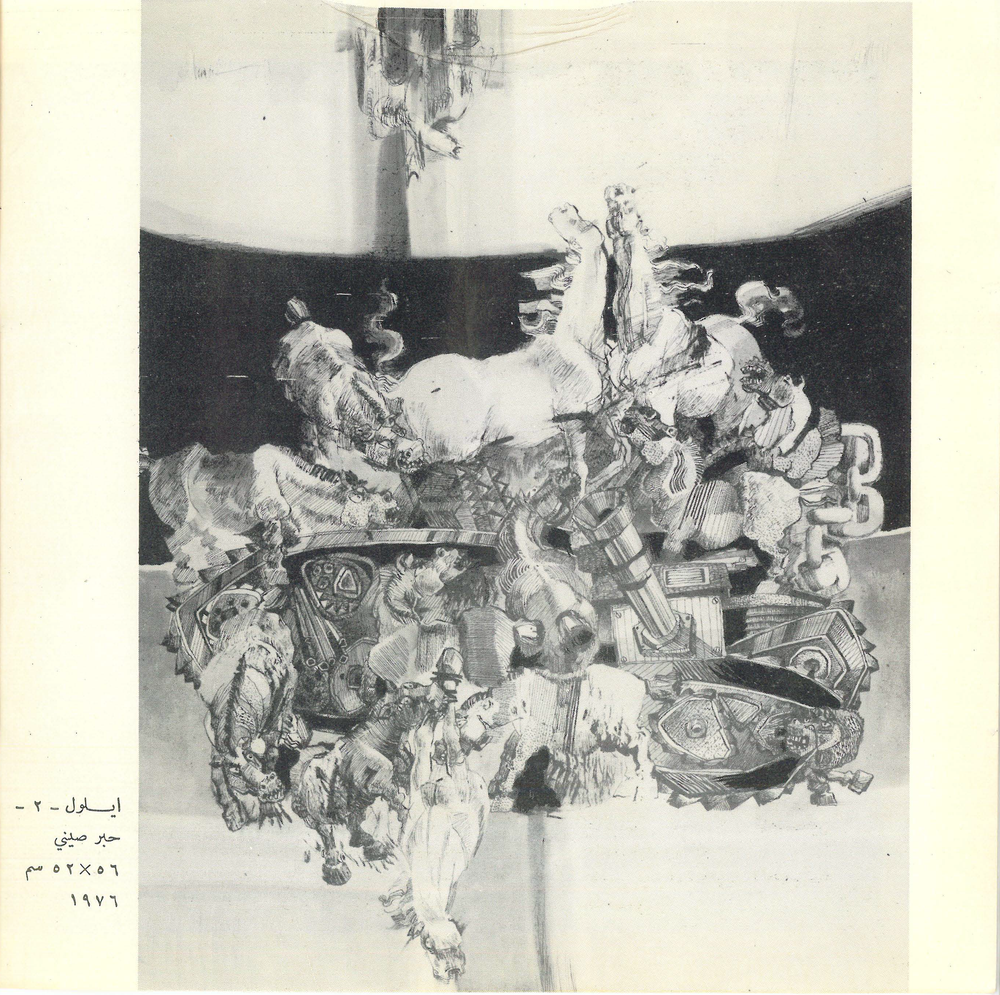
A photograph from the brochure of Youssef Abdelke’s exhibition at the People’s Hall, 1976
showing the artwork “September 2,” Chinese ink on paper
The experience of the FAA in Syria illustrates how, during the 1970s, nationalist sentiment, artistic aspiration, and authoritarian control converged to produce a deeply contradictory cultural landscape. On the one hand, the FAA offered artists an important platform for expression, experimentation, and regional exchange. On the other, it mobilized their works and the events they participated in to serve an official discourse that redefined art as a moral and nationalist instrument. Yet works that escaped such direct instrumentalization reveal that the Syrian cultural field was neither monolithic nor easily reduced to a single narrative. Rather, it was characterized by multiple, overlapping identities and diverse orientations, ranging from political commitment and creative ambition to forms of critical reflection. Understanding Syrian art in this context requires moving beyond the simplistic categories such as official or subordinate to power. The cultural field was not merely a vehicle for propaganda; it also contained spaces of resistance and internal critique - spaces that remained open to reflection and interpretation.
Footnotes:
[1] In this English translation, the Arabic term qawmi is rendered as ‘nationalist’ to reflect its pan-Arab and ideological connotations, distinguishing it from watani which relates strictly to the Syrian national state.
[2] “The Assocition’s objectives,” Al-Funoon al-Jameelah, a non-periodical publication issued by the FAA, Damascus, FAA, 1972, n.p.
[3] bid.
[4] Afif Bahnassi, “Socialism and Art,” in: Majallat Al-Ma'rifah Magazine, Issue 43, Damascus, Ministry of Culture, July 1965, pp. 112-116.
[5] Ibid, p. 113.
[6] Ibid, p. 116.
[7] Al-Funoon al-Jameelah, a non-periodical publication, 1972, n.p.
[8] Al-Funoon al-Jameelah, a non-periodical publication, 1973, n.p.
[9] See: Al-Khalidi, Forty Years of Fine Arts in the Syrian Arab Republic, 1971, pp. 3-13.
[10] Al-Funoon al-Jameelah, a non-periodical publication, 1972, n.p.
[11] Ibid.
[12] Ibid.
[13] Ibid.
[14] As stated, for example, in the introduction to the union's bulletin for 1972.
[15] Ibid.
[16] For more topic, see: Art in the Struggle for the Socialist World System: Foreign Cultural Colicy of the GDR in Africa and the Middle East, edited by Christian Zahrendt, Stuttgart, Franz Steiner Verlag, 2017, pp. 119-124.
[17] See: “On Popular Democracy,” Party Preparation Series 10 (The Regional Command of the Baath Party, 1966), p. 98, in Shams al-Din al-Kilani, An Introduction to Syrian Political Life: From the Establishment of the Entity to the Revolution, 2017, Chapter 6, Arab Center for Research and Policy Studies, Beirut, Kindle Edition, n.p.
[18] See: Al-Munadil, an internal magazine of the Baath Party, Issue 19 (March 1968), p. 20, quoted from: Shams Al-Din Al-Kilani, An Introduction to Syrian Political Life, 2017, Chapter 6, n.p.
[19] Lisa and Dean Ambiguities of Domination: Politics, Rhetoric, and Symbols in Contemporary Syria Chicago, University of Chicago, 1999
[20] Ibid., p. 19.
[21] Mahmoud Shahin, “Omar Hamdi and the Global Reach of Visual Achievement,” Malva Omar Hamdi, edited by Hanaa Daoud and Irfan Hamdi, Dar Al Takween for Authorship, Translation and Publishing, Damascus, 2016, p. 77.
[22] Presidential Decree, in The Second Annual General Exhibition of Artists of the Syrian Arab Republic, exhibition booklet 1972, Damascus, Ministry of Culture, pp. 2-3.
[23] See: Fatima Shaaban, “Khouzayma Alwani: The Arab Man is a Wounded Horse,” 30 January 2006, accessed 24 February 2026, https://www.aletihad.ae/article/47298/2006/خزيمة-علواني:-الإنسان-العربي-حصان-جريح
[24] Al-Funoon al-Jameelah, a non-periodical publication 1972, n.p.
[25] Ibid.
[26] Mahmoud Hammad, “An Opinion on Nationalist Art,” Damascus, FAA, 1972. It’s not known whether the text was written as a letter or as an opening address delivered by the artist at the festival. The text is available in the Mahmoud Hammad Archive at masaarchive.org, , https://masaarchive.org/ar/archiveDetails/?item=2023_06_Mahmoud+Hammad+Archive+collection&open=Writings&objectId=9870 accessed 8 June 2025.
[27] See: Abdul Aziz Alloun, The Turning Point of the Sixties in the History of Contemporary Fine Arts in Syria, 2003, pp. 91- 96.
[28] See: “Recommendations of the First Arab Conference on Fine Arts,” in Al-Funoon al-Jameelah, a non-periodical publication, 1971, n.p.
[29] “The Head of the Founding Committee of the Union of Arab Plastic Artists Discusses Union Goals and Future Projects: When Will the First Conference of Arab Plastic Artists be Beld?” al-Ithaa wat-Tilvizyon, a bimonthly magazine, issue 38, 22 July 1971, Baghdad.
[30] Al-Funoon al-Jameelah, a non-periodical publication issued by the FAA, 1973, n.p.
[31] According to Nada Shammout's article in Transregional Solidarity, May 2018, https://mezosfera.org/transregional-solidarity, accessed 8 January 2026.
[32] Hanan Naoumi, “The Fiftieth Anniversary of the First Arab Biennale in Baghdad,” 17 March 2024, Elaph, https://elaph.com/Web/Culture/2024/03/1532037.html; Farid al-Zahi, “Arab Biennales.. An Early Death,” 10 February 2018, Diffah, https://diffah.alaraby.co.uk/diffah/arts/2018/2/7/البينالات-العربية-موت-مبكر, accessed 8 June 2025.
[33] Al-Funoon al-Jameelah, a non-periodical publication, 1973, n.p.
[34] Charlotte Bank, The Contemporary Art Scene in Syria: Social Critique and an Artistic Movement, 2020, Routledge, New York and London, p. 69.